
Criminal Court Records in Holmes County
A criminal court record is the case file a court clerk opens once charges are filed against a defendant. It is not the same as an arrest report or a jail booking sheet. The court file follows the case itself. It holds the charging document, every motion, each hearing date, the plea, the verdict or plea deal, and the sentence. In Holmes County, the Circuit Clerk keeps felony case files, indictments, and related criminal papers filed in Circuit Court. That office also issues subpoenas, draws juries, and stores judgments.
Two court levels produce most criminal records here. The 21st Circuit Court handles felony prosecutions and serious criminal matters, with Judge Jannie M. Lewis presiding locally. Holmes County Justice Court handles misdemeanors, DUIs, county ordinance violations, and the affidavits that start many criminal cases. Justice Court also holds felony initial appearances. Its judges sit at the jail three times each week so an arrested person sees a judge within three days. The county courts page lists each court and its judges. For a closer look at the charges that open a case, the arrest and court charge records page covers the charging side in more detail.
Search Holmes County Criminal Records
Holmes County has no single county website that searches every criminal case. Circuit Court files run through Mississippi Electronic Courts, the statewide filing and case-management system. Public online access to that system needs a PAMEC account. Statewide electronic filing for all circuit, chancery, and county courts was completed in 2025, so newer files are entered online.
- Open the Mississippi Electronic Courts portal and log in, or register for a PAMEC account if you do not have one.
- Search by the defendant name or by the case number.
- Narrow the results by court, case type, and filing date to find the right file.
- Open the case to read the docket, charges, plea, and disposition.
- Ask the Circuit Clerk for a certified copy when an official document is needed, since online views are not certified.
Not every record sits online. Sealed files, older paper files, and confidential matters need a clerk. Call the Circuit Clerk at 662-834-2476 for felony files. Call Justice Court at 662-834-4565 for misdemeanor and DUI cases. A written records request works when a file cannot be viewed in person.
Stages of a Holmes County Criminal Case
A criminal case moves through set stages, and each stage leaves a mark in the record. The docket lists every step in date order. Reading the stages in sequence shows how a case began and how it ended.
Case flow: Charges Filed › Arraignment › Pretrial and Motions › Plea or Trial › Disposition › Sentencing
Charges start the file, through an affidavit, a complaint, or a grand jury indictment. At arraignment, the judge reads the charges and the defendant enters a plea. Pretrial work follows, with motions, evidence exchange, and hearings. The case then ends in a plea deal or a trial. The disposition records that outcome. When there is a conviction, sentencing sets the punishment.
Felony cases often begin in Justice Court for an initial appearance. They move to Circuit Court after a grand jury returns an indictment. The record can span both court levels, so the same case may appear in two clerks' files.
What a Holmes County Criminal Record Shows
A criminal case file packs many fields into one record. Each field answers a different question about the case. The table below lists the main parts of a Holmes County criminal court file and what each one tells you.
| Field | What It Shows |
|---|---|
| Case Number | The unique number the court assigns to track the case. |
| Court | Whether the case sits in Circuit Court, Justice Court, or another level. |
| Parties | The State of Mississippi as prosecutor and the named defendant. |
| Charges | The offenses filed, with statute references and severity level. |
| Attorneys | The prosecutor, defense counsel or public defender, and pro se status. |
| Docket Events | Each filing, hearing, continuance, and order in date order. |
| Plea | The defendant's response, such as guilty, not guilty, or no contest. |
| Disposition | The outcome, such as dismissed, convicted, or acquitted. |
| Sentence | Any jail time, probation, fines, costs, or restitution imposed. |
Some details stay out of the public copy. Clerks redact Social Security numbers, financial account numbers, and protected information about minors. A file may be released as a redacted copy rather than a full image.
Reading Dispositions and Sentences
The disposition is the heart of a criminal record. It states how each charge ended. A guilty plea, a jury verdict, a dismissal, and an acquittal all read differently in the file. A handful of terms come up again and again.
- Arraignment
- The hearing where charges are read and the defendant enters a plea.
- Nolle prosequi
- The prosecutor's decision not to move forward on a charge.
- Disposition
- The final outcome of a case or a single charge.
- Probation
- Supervised release ordered instead of or after jail time.
- Sentence
- The punishment set by the court after a conviction.
Sentences appear with terms, amounts, and conditions. A sentence may list jail or prison time, fines, court costs, restitution to a victim, and probation terms. Some charges end in a deferred outcome or a reduced charge. The docket shows whether a sentence was served, suspended, or appealed.
Charges and Convictions in Holmes County
Being charged is not the same as being convicted. A criminal court record can show charges that were dropped, dismissed, or that ended in an acquittal. A charge is only an accusation. A conviction is a finding or plea of guilt. The table sets the two side by side.
| Charge | Conviction | |
|---|---|---|
| Stage | Accusation | Verdict or plea |
| Burden of Proof | Probable cause | Beyond reasonable doubt |
| Public Record | Yes | Yes |
Check the disposition before drawing any conclusion from a charge. A felony charge in the file may have been reduced to a misdemeanor. It may have been dropped through a nolle prosequi entry. The charge stays in the record even when it never led to a conviction.
Prosecutors in Holmes County Criminal Cases
Two sides shape a felony file in Circuit Court. The District Attorney prosecutes for the State of Mississippi. The DA reviews felony matters, presents indictments, and handles pleas, dismissals, and sentencing recommendations. Akillie Malone-Oliver serves as District Attorney for the 21st Circuit District, which covers Holmes, Humphreys, and Yazoo counties. The district office answers at 662-653-3191.
Defendants who cannot afford a lawyer may receive a court-appointed public defender. The Mississippi Office of State Public Defender lists felony-level defenders by county.
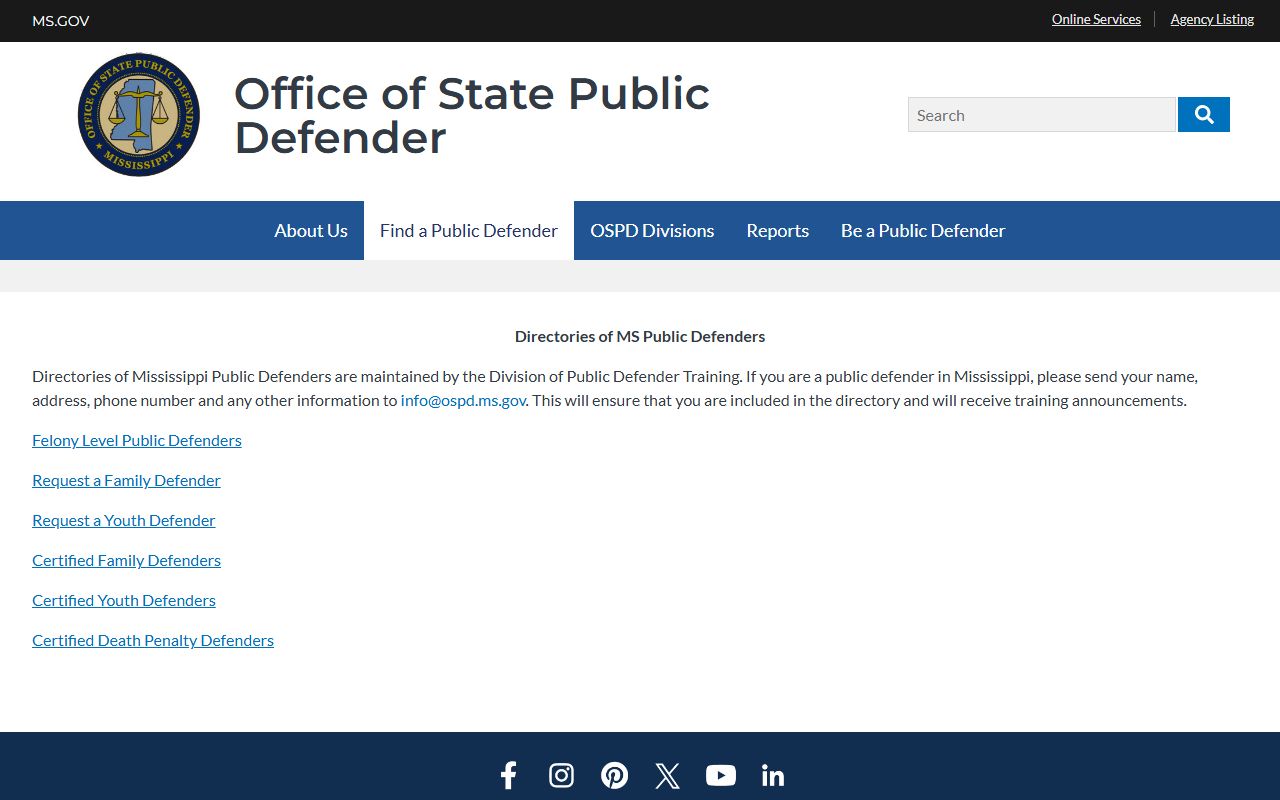
Three felony defenders appear in the Holmes County directory, and their contact details help defendants reach counsel early in a case.
Holmes County Felony Public Defenders
Charles Irvin, 401 Legacy Park, Ste. A, Ridgeland, MS 39157 · 601-340-6800
Pearlene Jones, PO Box 1161, Lexington, MS 39095 · 662-230-1528
Alva Peyton Taylor, PO Box 268, Yazoo City, MS 39194 · 662-746-9711
Sealed vs. Expunged Records
Sealed and expunged do not mean the same thing. A sealed record stays in the court's custody but is closed to the general public. An expunged record is removed from public access by court order, and the law treats the matter as though it never happened. Mississippi sets specific rules for each path.
| Sealed | Expunged | |
|---|---|---|
| Visibility | Hidden from public | Treated as never existed |
| Law Enforcement | Limited access | Very limited access |
| Eligibility | Youth court and certain protected files | Some first offenses and limited cases by petition |
Under Miss. Code Section 99-19-71, expunction can reach certain first-offense misdemeanors, some felony convictions after a waiting period, and nonconviction cases where charges were dismissed, dropped, or ended in acquittal. An expunction begins in the court that handled the case. The petitioner files a written request, the prosecutor may object, and the judge decides.
Note: An expunction order must reach the court clerk, the arresting agency, and state repositories before public access to the record is fully removed.
Public Access to Holmes County Records
Most criminal court files in Holmes County are public records. State law lets people inspect and copy them unless a specific rule says otherwise. The first step is to identify the office that holds the file. Felony and Circuit Court files route to the Circuit Clerk. Misdemeanor, DUI, and initial-appearance matters route to Justice Court. These open the same way other Holmes County court records do.
Key Statutes:
Miss. Code § 25-61-1 et seq. - Public records are open for inspection and copying unless a law exempts them.
Miss. Code § 43-21-251 - Youth court records and their contents are confidential except as youth-court law allows.
Certified copies still require a clerk, even when a docket can be viewed online. The Public Records Act also lets offices charge reasonable fees for searching and copying. Confidentiality rules for juveniles, sealed files, and expunged cases override the general right of access.
Restricted Holmes County Criminal Records
Some criminal matters never open to the public. Youth Court files are confidential under state law, and the court is closed to the public and the media. Violent juvenile cases can transfer to Circuit Court, where access may differ. Sealed files, expunged cases, and adoption records stay closed.
Mental health and commitment proceedings hold sensitive medical details and are treated as restricted. Ongoing cases may show limited public detail while motions are pending. Records are often released as redacted copies that hide private identifiers. When a file is restricted, the clerk can confirm what part, if any, is open.
Note: Youth court confidentiality under Section 43-21-251 limits who may view juvenile records, even when a related adult case is public.
Background Check Considerations
Court records are public, but using them for hiring or housing follows different rules. A formal background check for employment, credit, tenancy, or insurance falls under the federal Fair Credit Reporting Act. That process uses regulated consumer reporting agencies. A casual name search of court files is not the same as an FCRA-compliant report.
Important: This site is not a consumer reporting agency under the FCRA, and its information may not be used for credit, employment, tenant, or insurance decisions.
Anyone making an FCRA-covered decision should use a licensed screening provider. Court files can be incomplete or out of date. Verify any detail with the clerk before acting on it.